
You take a screenshot of a threatening message. Or you record your screen during a heated online exchange. In that moment, it feels like you’ve secured proof. Something solid. Something undeniable.
But here’s the part most people don’t think about. Will that screenshot actually stand in court?
Digital conversations now shape business disputes, family conflicts, harassment complaints, and even criminal trials. WhatsApp chats, Instagram DMs, email threads, screen recordings of calls. They are everywhere. Naturally, courts are seeing more of them too.
So the real question is not whether screenshots and screen recordings valid in court is possible. The real question is under what conditions they become legally reliable evidence.
In India, courts do accept electronic records. But acceptance is not automatic. There are legal requirements, technical expectations, and procedural safeguards that determine whether screen recordings and screenshots in Indian court will be treated as credible proof or dismissed as questionable copies.
Think of it like this. A screenshot is like a photograph of a document. It may show what was on the screen at one point. But unless the source, timing, and authenticity are established, the other side can easily challenge it.
This article walks you through that reality clearly. We’ll break down how courts evaluate digital evidence, why it gets challenged, and how it can be strengthened. No legal jargon. Just a practical guide from a forensic and legal lens.
What Counts as Digital Evidence in Court?
Before we debate whether screenshots and screen recordings valid in court is a settled issue, we need to understand what the law actually treats as digital evidence.
In simple terms, digital evidence is any information stored, transmitted, or generated by an electronic device. That includes emails, chat messages, CCTV footage, call logs, server logs, social media posts, cloud backups, and yes, screenshots and screen recordings.
Under the Indian Evidence Act, electronic records are legally recognized. Courts do not treat them as casual printouts. They are considered documentary evidence, provided they meet certain statutory requirements.
An electronic record can exist in two forms
- The original device itself
- A copy produced from that device
This distinction matters. A mobile phone containing the original WhatsApp chat is stronger evidence than a cropped screenshot of that chat. What this really means is the closer you are to the source device, the stronger your legal footing becomes.
When discussing screen recordings and screenshots in Indian court, courts examine three core factors
- Authenticity
- Integrity
- Source reliability
Is the file genuine? Has it been altered? Can it be traced back to a specific device or system?
Here’s the thing. A screenshot by itself is just an image file. It does not automatically prove who sent the message, whether the content was edited, or whether the conversation is complete. The court wants more than a visual. It wants technical assurance.
This is where certification under Section 65B comes in. Without satisfying statutory requirements, even relevant electronic evidence can be challenged and excluded.
So digital evidence is not about what you can see. It is about what you can prove.
Are Screenshots and Screen Recordings Valid in Court?
Short answer. Yes, they can be. But not automatically.
Indian courts do recognize electronic records as admissible evidence. That includes screenshots, screen captures, and video recordings taken from a device. So in principle, screenshots and screen recordings valid in court is absolutely possible.
The real issue is compliance.
Under Section 65B of the Indian Evidence Act, any electronic record presented as evidence must be accompanied by a proper 65B certificate. This certificate confirms
- The device used
- The manner in which the record was produced
- That the computer or device was functioning properly
- That the copy is a true and accurate reproduction
Without this certificate, courts have repeatedly rejected electronic evidence, even if the content looks genuine.
The Supreme Court of India has clarified in multiple judgments that Section 65B compliance is mandatory when you are not producing the original device itself.
Here’s what this really means in practical terms.
If you walk into court with only a printed screenshot, no certificate, and no explanation of the source device, the opposing party can challenge its admissibility. The judge may refuse to rely on it.
On the other hand, if you produce
- The original phone or system
- A proper 65B certificate
- Clear identification of the sender and context
- No visible signs of tampering
then screen recordings and screenshots in Indian court become much stronger.
Courts are not against digital evidence. They are against unreliable digital evidence.
So validity is not about format. It is about foundation.
Why Screenshots and Recordings Can Be Challenged?
Here’s the uncomfortable truth. A screenshot feels solid. A screen recording feels even stronger. You can see it. You can replay it. It looks convincing.
But in court, visual proof is not the same as legal proof.
Even though screenshots and screen recordings valid in court is legally possible, they are also among the most frequently challenged forms of digital evidence. Why? Because they are easy to manipulate and hard to verify without technical backing.
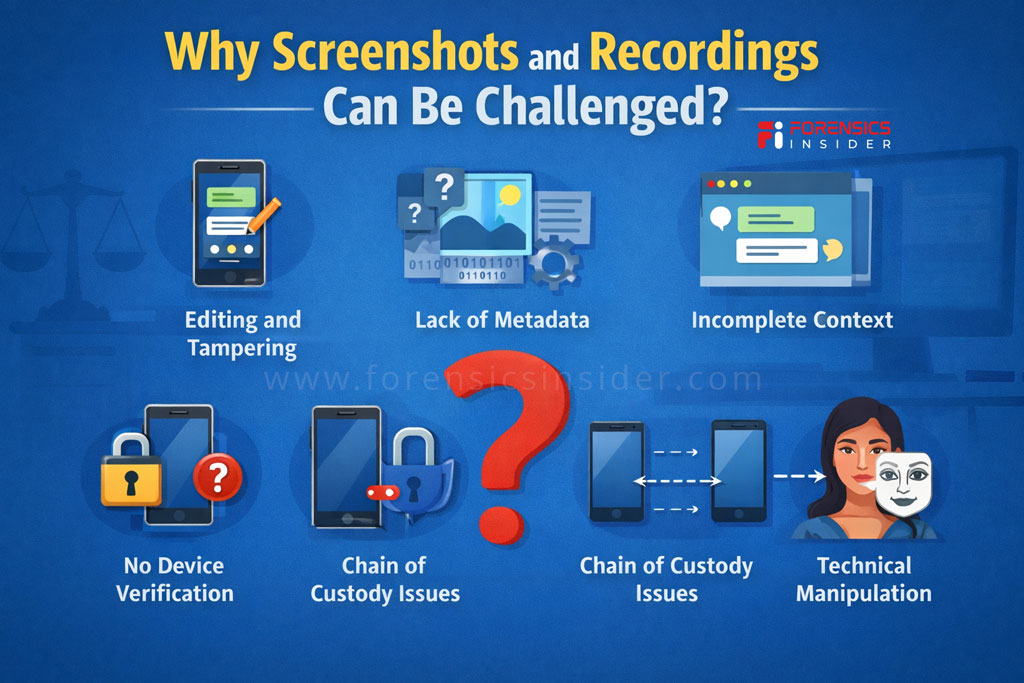
Let’s break down the common reasons.
1. Editing and Tampering
Image editing takes minutes. Cropping, altering text, overlaying messages, changing timestamps. None of this requires advanced skills anymore.
If the other side alleges tampering, the burden shifts to proving authenticity. Without forensic validation, screen recordings and screenshots in Indian court can quickly lose credibility.
2. Lack of Metadata
A screenshot is just an image file. It may not carry reliable metadata about the original message, sender identity, or server level timestamps.
3. Incomplete Context
Screenshots often capture fragments of a conversation. Messages before or after may be missing. That opens the door to arguments about selective presentation or misleading context.
4. No Device Verification
If the original device is not produced, the opposing party can argue that the screenshot was created on another device or fabricated entirely.
This is where compliance with Section 65B of the Indian Evidence Act becomes critical. Without proper certification, admissibility becomes vulnerable.
5. Chain of Custody Issues
Digital files are easy to forward. Once a screenshot is shared multiple times across devices, tracing its origin becomes harder.
6. Technical Manipulation and Deepfakes
With modern tools, even screen recordings can be fabricated or stitched together. Overlay software can simulate notifications. Deepfake techniques can alter voice or video elements.
Common Grounds of Objection in Indian Courts
Now let’s get practical.
Even when screenshots and screen recordings valid in court is legally possible, opposing counsel will look for technical weaknesses. In Indian litigation, digital evidence is often attacked at the admissibility stage before the court even evaluates the content.
Here are the most common grounds of objection.
1. Absence of Section 65B Certificate
This is the most frequent objection.
Under Section 65B of the Indian Evidence Act, electronic records must be accompanied by a proper certificate if the original device is not being produced.
If a party files only printouts or pen drive copies without certification, the other side can argue that the material is inadmissible. Courts have upheld this requirement consistently, especially after clarifications by the Supreme Court of India.
2. Doubt About Authenticity
The defense may argue that the screenshot was edited, cropped, or fabricated.
If there is no forensic examination, no metadata extraction, and no device verification, screen recordings and screenshots in Indian court can be labeled unreliable.
3. Source Not Proven
Where did the file originate?
From which device?
Who had access to that device?
If the source device is not identified clearly, the court may treat the evidence as secondary and suspicious.
4. Incomplete Conversation
Selective screenshots are a common issue. Opposing counsel may argue that the extract is misleading and that the full conversation tells a different story.
5. Device Not Produced
If serious allegations are involved, the court may expect the original mobile phone or computer to be produced.
6. Chain of Custody Gaps
If the digital file has passed through multiple hands without documentation, objections may be raised regarding possible alteration.
Role of Digital Forensic Examination
This is where things shift from assumption to proof.
Anyone can take a screenshot. Anyone can record a screen. But when the dispute becomes serious, courts look for technical validation. That is the role of digital forensic examination.
Even though screenshots and screen recordings valid in court is legally recognized, their strength increases dramatically when backed by forensic analysis.
Let’s break down what a forensic expert actually does.
1. Device Acquisition
Instead of relying on forwarded images, a forensic examiner creates a structured extraction from the original device. This preserves the data in its native environment.
- The process documents
- Device details
- Extraction method
- Time of acquisition
- Hash values for integrity
Now the evidence is not just a picture. It is a documented digital artifact.
2. Metadata Analysis
Screenshots alone reveal limited technical data. But when extracted from the source device, investigators can analyze
- File creation timestamps
- Modification timestamps
- Application data logs
- System time settings
This helps answer critical questions. Was the screenshot taken on that device? Was the system clock manipulated? Has the file been edited?
3. Hash Verification
Forensic tools generate hash values for extracted files. These act like digital fingerprints.
If the hash remains consistent throughout examination, integrity is preserved. That strengthens arguments that screen recordings and screenshots in Indian court are authentic and untampered.
4. Timeline Reconstruction
Examiners correlate message timestamps with system logs, notification logs, and application databases.
This allows reconstruction of the surrounding context. Not just one image. The sequence of events.
5. Detecting Tampering
Advanced forensic analysis can identify signs of
- Image editing
- Metadata inconsistencies
- Video stitching
- Overlay manipulation
This directly addresses the most common objections raised against screenshots and screen recordings valid in court.
Here’s the bigger picture.
A screenshot is a claim.
A forensic examination is verification.
Real World Scenarios
Legal debates feel abstract until you see how they play out in real disputes. Let’s look at where screenshots and screen recordings valid in court actually become practical issues.
1. WhatsApp Threats and Harassment
Someone receives threatening messages. They take screenshots immediately. Later, those screenshots are filed in a complaint.
In many cases, courts accept such material, especially when supported by the original phone and a Section 65B certificate under the Indian Evidence Act.
But if only cropped images are produced without device verification, the defense may argue fabrication or selective editing. That is where screen recordings and screenshots in Indian court get tested.
2. Social Media Defamation
Imagine a defamatory Instagram story that disappears after 24 hours. The victim captures a screen recording before it vanishes.
That recording may become crucial evidence. However, the opposing party can question whether the account was genuine, whether the video was altered, or whether the username was manipulated.
3. Workplace Misconduct
In internal corporate disputes, employees often rely on email screenshots or recorded virtual meetings.
If the matter escalates to litigation, the court will look beyond the image. It will examine whether the company’s server logs support the content. Was the email actually sent? From which IP? At what time?
4. Business Contract Disputes
Many agreements today happen over chat. Payment confirmations, delivery commitments, negotiation terms.
When disputes arise, parties present chat screenshots as proof of promises made. Courts may accept them, but only after verifying authenticity and compliance requirements.
5. Matrimonial and Family Cases
Chat messages, call recordings, and social media interactions frequently appear in matrimonial litigation.
Here’s what these scenarios show.
Screenshots and screen recordings valid in court is not a theoretical question. It happens daily.
But the difference between acceptance and rejection usually comes down to one thing.
How to Make Screenshots and Recordings Stronger Evidence?
If you are relying on digital proof, do not wait for the objection stage to think about strength. Preparation starts the moment you capture the evidence.
Yes, screenshots and screen recordings valid in court is possible. But their reliability depends on how you preserve and present them.
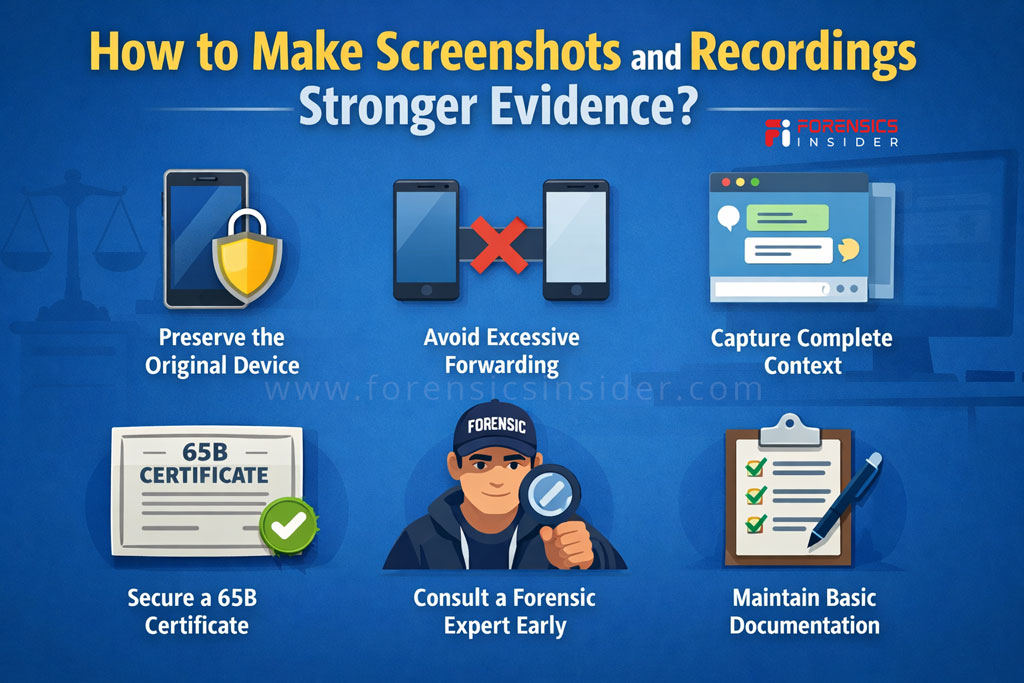
Here is how to make them stronger.
1. Preserve the Original Device
Do not factory reset your phone. Do not replace it immediately. And, Do not overwrite data casually.
The original device is your strongest asset. Courts trust primary sources more than forwarded files. When screen recordings and screenshots in Indian court are backed by the source device, objections weaken.
2. Avoid Excessive Forwarding
Once a file is shared across multiple devices, tracing its origin becomes harder. Keep the original capture safely stored. If you must share, maintain a clean copy untouched.
Chain clarity builds credibility.
3. Capture Complete Context
Do not rely on cropped snippets. Capture full conversations, visible timestamps, and usernames. If possible, record scrolling through the entire chat so context is preserved.
Selective evidence invites suspicion.
4. Secure a Section 65B Certificate
Under Section 65B of the Indian Evidence Act, electronic records need certification when the original device is not directly produced in court.
Get this prepared properly. A missing certificate is one of the most common reasons screenshots and screen recordings valid in court are challenged.
5. Consult a Digital Forensic Expert Early
If the matter is serious, involve a forensic professional before the device is altered. Proper extraction preserves metadata, generates hash values, and documents the acquisition process.
This transforms a simple image into technically supported evidence.
6. Maintain Basic Documentation
Note the date and time you captured the screenshot. Record the device used. Keep related communication intact.
Small details often become important during cross examination.
Limitations of Digital Evidence
Digital evidence feels powerful. It looks precise. It carries timestamps. And, It appears objective.
But here’s the reality. It is not invincible.
Even though screenshots and screen recordings valid in court is legally possible, digital material comes with technical limitations that courts are increasingly aware of.
Let’s look at them clearly.
1. Ease of Manipulation
Image editing tools are everywhere. Text can be altered. Names can be changed. Timestamps can be overlaid. Entire conversations can be fabricated using cloning apps.
What looks authentic at first glance may not be original. That is why screen recordings and screenshots in Indian court are often tested for tampering.
2. Deepfakes and Synthetic Media
AI driven tools can generate fake video, audio, and chat interfaces. Screen overlays can simulate real notifications. Voice cloning can imitate speakers convincingly.
Courts now understand that seeing is not always believing.
3. Metadata Can Be Altered
While metadata helps establish authenticity, it is not untouchable. Advanced users can modify file properties. System clocks can be manipulated before capturing a screenshot.
Without proper forensic acquisition, metadata alone may not settle the issue.
4. Context Can Be Distorted
A single screenshot rarely shows the full conversation. Missing messages before or after can change the meaning entirely.
Courts prefer complete records over isolated extracts because partial evidence can mislead.
5. Device Dependency
Digital evidence is tied to devices and systems. If the original device is lost, damaged, or replaced, proving authenticity becomes harder.
This is where procedural safeguards under Section 65B of the Indian Evidence Act become critical.
6. Storage and Data Volatility
Digital data can be overwritten, auto deleted, or altered through routine updates. Messaging apps sync across devices. Cloud backups change states over time.
What existed yesterday may not exist today in the same form.
Final Takeaway
We live on our screens. Arguments happen on WhatsApp. Deals close over email. Threats arrive in DMs. Naturally, when disputes reach court, people rely on screenshots and recordings.
So are screenshots and screen recordings valid in court?
Yes. They can be.
But they are not self proving.
Indian courts do recognize electronic evidence under the Indian Evidence Act. At the same time, they demand procedural discipline. Proper certification. Source clarity. Authenticity proof. Without that, screen recordings and screenshots in Indian court can be challenged, sometimes successfully.
Here’s what this really means.
A screenshot is not weak by default.
It becomes weak when unsupported.
If the original device is preserved, a Section 65B certificate is properly prepared, and forensic validation confirms integrity, digital evidence can carry serious weight. In many cases, it becomes the turning point.
On the other hand, cropped images, forwarded files, missing context, and no certification create doubt. And in court, doubt is powerful.
Think of digital evidence like a photograph of a crime scene. The photo matters. But the camera, the timestamp, the chain of custody, and the testimony behind it matter just as much.
Use screenshots wisely. Preserve devices carefully. Involve technical expertise early if the dispute is serious.
Because in legal battles, it is not just about what you captured.
It is about what you can prove.