You don’t notice it, but every click, search, and swipe leaves something behind. A login time. A location ping. A file opened for just a few seconds. On their own, these feel meaningless. But together, they start telling a story.
That’s where digital forensics comes in.
At its core, digital forensics is about finding, preserving, and interpreting data from digital devices in a way that holds up in real-world investigations. It’s not just about recovering deleted files. It’s about understanding behavior. Who did what, when, and how. Whether it’s a cybercrime, a corporate breach, or even a missing person case, investigators rely on structured methods to make sense of scattered data.
This is exactly why the phases of digital forensics matter so much.
Without a clear process, evidence can get overlooked, altered, or even dismissed in court. The structured stages of digital forensics act like a roadmap. They guide investigators from the moment a potential piece of evidence is found all the way to presenting clear, defensible conclusions. Think of it like reconstructing a timeline from fragments. If you skip steps or rush through them, the story falls apart.
Here’s what we’re going to do.
Instead of throwing definitions at you, we’ll walk through the steps in cyber forensics the way they actually unfold in a real case. One stage leads to the next. Each decision affects what comes after. By the end, you won’t just know the process. You’ll see how each phase fits together to uncover the truth hidden in digital traces.
What Are the Phases of Digital Forensics?
Think of an investigation where thousands of files, logs, and hidden traces are scattered across devices. Without a clear path, it would feel like searching in the dark. That’s exactly why investigators rely on the phases of digital forensics.
In simple terms, these are structured steps used to find, handle, and interpret digital evidence in a reliable way. Instead of guessing or jumping to conclusions, investigators follow a defined process that ensures nothing important is missed and everything holds up under scrutiny. These stages of digital forensics bring order to what would otherwise be chaos.
What this really means is every action taken during an investigation is intentional. From the moment a device is identified to the point where findings are presented, each step builds on the previous one. That’s why the steps in cyber forensics are followed carefully, often in sequence, to maintain accuracy and credibility.
Here’s a quick overview of how these stages typically flow:
- Identification – Spotting potential sources of digital evidence
- Preservation – Protecting data from being altered or lost
- Collection (Acquisition) – Gathering data in a forensically sound way
- Examination – Sorting and filtering relevant information
- Analysis – Interpreting data to uncover what actually happened
- Documentation & Reporting – Recording findings clearly and accurately
- Presentation – Explaining conclusions to stakeholders or in court
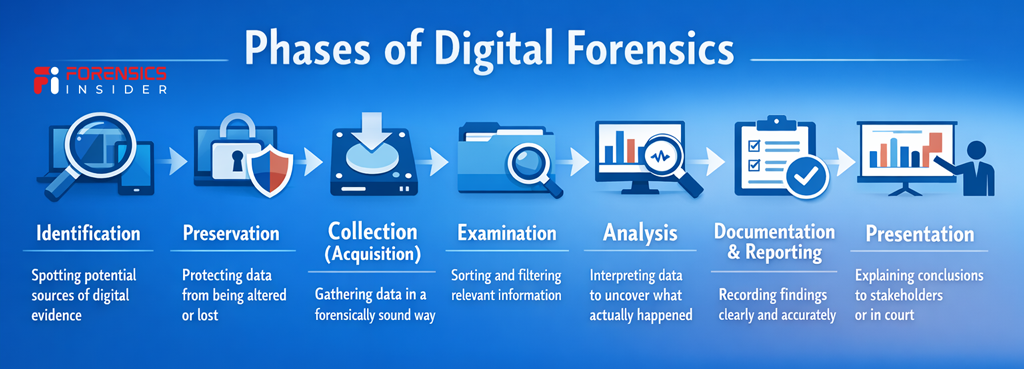
At first glance, this might look like a simple checklist. But in reality, each stage plays a critical role. Miss one, or handle it poorly, and the entire investigation can fall apart. That’s why understanding the phases of digital forensics isn’t just helpful. It’s essential.
Stage 1: Identification
Every investigation starts with one simple question. Where should we look?
Identification is the first and one of the most critical phases of digital forensics. This is where investigators figure out what might contain useful evidence. It sounds straightforward, but this step sets the direction for everything that follows. Miss something here, and the rest of the investigation may never recover.
In plain terms, identifying evidence means spotting all possible sources where relevant data could exist. This includes obvious places like laptops and smartphones, but it goes much deeper. Evidence can live in network traffic, server logs, cloud storage, email systems, USB drives, and even IoT devices. In modern cases, the steps in cyber forensics often extend beyond physical devices into distributed environments where data is constantly moving.
A simple way to understand this is to think about a physical crime scene. Imagine investigators arriving at a location. They don’t just look at the main area. They scan everything. Footprints, fingerprints, nearby objects, entry and exit points. Each detail could matter. The same idea applies in the stages of digital forensics. Every system, connection, and activity could hold a piece of the story.
What makes this stage so important is accuracy at the very beginning.
If investigators overlook a device or fail to recognize a key data source, that evidence might be lost forever. On the other hand, identifying too many irrelevant sources can waste time and resources. So the goal is balance. Be thorough, but be precise.
This first step in the phases of digital forensics is not just about finding data. It’s about knowing where the truth might be hiding before it disappears.
Stage 2: Preservation
Once potential evidence is identified, the next priority is simple. Don’t let it change.
Preservation is one of the most sensitive phases of digital forensics because even a small alteration can compromise the entire case. Digital data is fragile. Opening a file, connecting a device, or even powering it on can modify timestamps or overwrite traces. That’s why investigators treat evidence as something that must remain exactly as it was found.
At the core of this stage is integrity. This means the data should stay complete, unaltered, and verifiable from the moment it’s collected to the moment it’s presented. In the stages of digital forensics, maintaining integrity is what gives evidence its credibility. If there’s any doubt that data was changed, it may not be accepted in legal or professional settings.
This is where the idea of chain of custody comes in.
Think of it as a detailed log that tracks every interaction with the evidence. Who collected it, when it was accessed, how it was stored, and who handled it next. Every step is recorded. In the steps in cyber forensics, this documentation ensures transparency. Anyone reviewing the case can trace the evidence back to its origin without gaps or confusion.
Now here’s the risk.
Improper handling can quietly destroy valuable information. A device might get overwritten. Logs might rotate and disappear. Data could be accidentally modified, making it unreliable. In some cases, even strong evidence gets dismissed simply because the preservation process wasn’t followed correctly.
That’s why this phase of digital forensics is less about analysis and more about discipline. Protect first, analyze later. If the evidence isn’t preserved properly, there may be nothing left to trust.
Stage 3: Collection (Acquisition)
Now comes the careful part. You’ve identified where the evidence lives and made sure it stays untouched. The next step is to collect it without changing anything.
Collection, often called acquisition, is one of the most technical phases of digital forensics. The goal is simple on the surface. Get the data. But the way it’s done makes all the difference. If handled poorly, this step can quietly alter or destroy the very evidence you’re trying to preserve.
Here’s the key idea. Investigators don’t usually work on the original device.
Instead, they create a forensic image. This is an exact bit by bit copy of the storage, capturing everything, including deleted files, hidden data, and system artifacts. It’s not the same as regular copying. A normal copy only transfers visible files. Imaging captures the entire structure of the device, even the parts users never see. That’s why, in the stages of digital forensics, imaging is considered the gold standard.
To make this happen, specialized tools are used. Tools like EnCase, FTK Imager, and Autopsy are designed to extract data in a controlled way. They often work alongside write blockers, which prevent any data from being written back to the original device during the process. In the steps in cyber forensics, these tools are essential because they combine precision with protection.
Another important layer here is verification.
After the data is acquired, investigators generate hash values. Think of it like a digital fingerprint. If even a single bit changes, the hash will be different. This helps confirm that the collected data is an exact match to the original.
What this really means is collection is not just about taking data. It’s about proving that nothing changed during the process. This phase of digital forensics ensures investigators can move forward with confidence, knowing the evidence they’re working with is authentic and intact.
Stage 4: Examination
At this point, investigators are no longer searching for evidence. They’re staring at it. The challenge now is making sense of a massive amount of raw data.
Examination is the phase where collected data gets filtered, sorted, and organized into something usable. In the phases of digital forensics, this step is about cutting through noise. A single device can contain millions of files, logs, and fragments. Not all of it matters. So the goal here is to separate what’s relevant from what isn’t.
This starts with structured filtering.
Investigators narrow down data based on file types, dates, user activity, and system behavior. Irrelevant files get pushed aside while potential evidence is brought into focus. In the stages of digital forensics, this process saves time and prevents important details from getting buried under unnecessary information.
Then comes deeper examination techniques.
Keyword searches are used to locate specific terms, conversations, or patterns. Deleted files are recovered and reconstructed. Hidden or encrypted data may be uncovered. Metadata is analyzed to understand when files were created, modified, or accessed. In many steps in cyber forensics, these small details begin to reveal intent and sequence.
But here’s the important shift.
Raw data becomes readable insight.
Instead of scattered bits and fragments, investigators start seeing structure. Conversations take shape. Timelines begin to form. Actions start to connect. This phase of digital forensics doesn’t yet answer the full story, but it builds the foundation for it.
What this really means is examination turns chaos into clarity. It prepares the evidence so that, in the next step, investigators can actually understand what happened.
Stage 5: Analysis
This is where everything starts to make sense.
Up to this point, investigators have collected and organized data. But data alone doesn’t tell the full story. Analysis is the phase where investigators begin connecting the dots. In the phases of digital forensics, this is where raw information turns into actual understanding.
Think of it like assembling a puzzle.
Each file, log, or recovered message is just a piece. On its own, it doesn’t say much. But when you start placing pieces together, patterns begin to appear. Investigators look for relationships between actions, timestamps, and user behavior. In the stages of digital forensics, this step is about seeing how everything fits.
One of the most powerful techniques here is timeline reconstruction.
Investigators map out events in chronological order. When was a file created? When was it accessed? And, When was it deleted? These details help build a sequence of actions. In many steps in cyber forensics, timelines reveal things that aren’t obvious at first glance. A login at an unusual time. A file transferred just before deletion. Small moments that change the entire narrative.
Then comes pattern recognition.
Repeated actions, unusual behavior, hidden intent. Investigators analyze communication patterns, system usage, and access points to understand not just what happened, but why. This is where behavior starts to emerge from data.
What this really means is analysis goes beyond evidence.
It transforms scattered data into meaningful insights. It answers the key questions. Who was involved. What actions were taken. When and how it happened. This phase of digital forensics is where the investigation moves from possibility to clarity.
Stage 6: Documentation & Reporting
By now, the investigation has uncovered what happened. But here’s the reality. If it isn’t documented clearly, it might as well not exist.
Documentation and reporting is one of the most overlooked yet critical phases of digital forensics. This is where investigators turn their findings into a structured report that others can understand, verify, and rely on. It’s not just about writing. It’s about translating complex technical work into something clear and defensible.
A good forensic report does a few things really well.
It explains what was found, how it was found, and why it matters. Every step taken during the investigation is recorded. Tools used, methods followed, timestamps observed. In the stages of digital forensics, this level of detail ensures that anyone reviewing the case can follow the same path and reach the same conclusions.
Accuracy and neutrality are everything here.
Investigators are not there to prove a theory. They are there to present facts. The report must stay objective, free from assumptions or bias. In many steps in cyber forensics, even strong evidence can lose its value if the reporting appears misleading or incomplete.
Then comes clarity.
Most people reading the report won’t be technical experts. Judges, lawyers, or business stakeholders need to understand what happened without digging through jargon. That means simplifying without losing meaning. Using clear language, structured sections, and logical flow so the story makes sense from start to finish.
And this is where legal relevance comes in.
A well-documented report can stand up in court. A poorly written one can be challenged, misunderstood, or even dismissed. This phase of digital forensics ensures that the work done so far holds its value beyond the investigation itself.
What this really means is documentation is not the end. It’s what gives the entire investigation its voice.
Stage 7: Presentation (Courtroom or Stakeholder Communication)
This is the moment where everything gets tested.
All the work done across the phases of digital forensics now has to stand in front of people who weren’t part of the investigation. Judges, lawyers, clients, or company leaders. Most of them won’t care about technical depth. They care about clarity, credibility, and whether the conclusions make sense.
So the job here shifts.
It’s no longer about finding evidence. It’s about explaining it.
Investigators need to break down complex findings into simple, understandable points. What happened, how it happened, and what it means. No jargon. No confusion. In the stages of digital forensics, this step is where communication becomes just as important as technical skill.
This is also where expert testimony comes in.
In legal cases, a digital forensic expert may be called to explain the investigation in court. They don’t just present findings. They walk through the entire process. How evidence was identified, preserved, collected, and analyzed. Every step must be explained clearly and confidently. In many steps in cyber forensics, the strength of the case depends on how well this explanation holds up under questioning.
And there will be questioning.
Opposing sides may challenge the methods, tools, or conclusions. That’s why investigators must be ready to defend their process. Not with opinions, but with documented proof. Every action taken should trace back to standard procedures followed during the phases of digital forensics.
What this really means is presentation is not just about speaking.
It’s about trust.
If the explanation is clear and the process is solid, the findings carry weight. If not, even strong evidence can lose its impact. This final stage ensures that the truth uncovered during the investigation is understood, accepted, and stands strong when it matters most.
How These Steps Work Together?
Here’s the thing. In real investigations, these stages don’t sit in neat boxes.
The phases of digital forensics are connected. Each step flows into the next. Sometimes they even overlap. Investigators move back and forth, refining their approach as new clues appear. It’s less like a straight line and more like a guided path that adjusts as the story unfolds.
Think of it as building a timeline in motion.
You start with identification, spotting a suspicious laptop and a cloud account. That naturally leads into preservation, making sure nothing on those sources gets altered. Once secured, collection begins, creating exact forensic images so the original data stays untouched.
Now, as examination starts, something interesting shows up. A deleted file gets recovered. That pushes the investigation deeper. Analysis kicks in, connecting that file to a specific user action late at night. Suddenly, what looked like routine activity starts to feel intentional.
And this is where the flow becomes clear.
Each stage feeds the next. Findings from examination influence analysis. Insights from analysis shape how the report is written. In the stages of digital forensics, this constant transition ensures that nothing is looked at in isolation.
Let’s walk through a quick scenario.
A company notices unusual data transfers. During identification, investigators flag an employee’s system and related server logs. In preservation, both sources are secured to prevent any tampering. Collection creates forensic copies of the system and logs.
During examination, large file transfers are filtered out and reviewed. Analysis reveals that sensitive files were accessed and moved to an external drive just before the employee resigned. Documentation captures every step, and during presentation, the findings are explained clearly to management or in legal proceedings.
What this really means is the steps in cyber forensics are not separate tasks.
They work together like parts of a single story. Each phase builds context, adds clarity, and strengthens the final conclusion. When followed properly, the process doesn’t just uncover data. It reveals the full picture behind it.
Challenges in Digital Forensics Phases
By now, the process might feel structured and controlled. But real investigations rarely stay that way for long.
The phases of digital forensics are designed to bring clarity, yet investigators often face obstacles that slow things down or complicate the entire process. These challenges don’t just appear in one stage. They can affect multiple stages of digital forensics at the same time.
One of the biggest hurdles is encryption.
Modern devices and platforms are built to protect user data, which is great for privacy but difficult for investigations. Strong encryption can block access to critical evidence, even when investigators know it exists. In many steps in cyber forensics, this means relying on alternative sources like metadata, backups, or network traces to piece together the story.
Then there’s the issue of scale.
Data today is massive. A single system can contain millions of files, logs, and hidden artifacts. During examination and analysis, filtering through this volume takes time and precision. Important evidence can easily get buried under irrelevant data. That’s why the stages of digital forensics often depend on smart filtering techniques and efficient tools just to stay manageable.
Another challenge is anti-forensic techniques.
Some individuals actively try to hide or destroy evidence. They may delete files, overwrite data, use anonymization tools, or manipulate timestamps. These actions are meant to mislead investigators. In the phases of digital forensics, this turns the process into more than just analysis. It becomes a careful effort to detect what’s missing or intentionally altered.
And then comes the legal side.
Digital evidence doesn’t always stay within one location or jurisdiction. Data might be stored in cloud servers across different countries, each with its own laws and regulations. This can delay access or restrict what investigators are allowed to collect. In many steps in cyber forensics, legal compliance becomes just as important as technical accuracy.
What this really means?
What this really means is digital forensics isn’t just about tools and techniques.
It’s about navigating complexity.
Each challenge tests how well the process is followed. And in the end, the strength of the investigation depends on how carefully these obstacles are handled without breaking the integrity of the evidence.
Tools Commonly Used in Digital Forensics
At this point, you might be thinking. All of this sounds complex. How do investigators actually do it?
The answer is tools. But here’s the important part. Tools don’t replace the process. They support it. In the phases of digital forensics, tools help investigators work faster, stay accurate, and handle large amounts of data without losing control.
Let’s keep this simple and practical.
One of the most well known tools is EnCase. It’s widely used in professional investigations for acquiring, examining, and analyzing digital evidence. What makes it powerful is its ability to handle complete forensic workflows while maintaining data integrity.
Then there’s FTK (Forensic Toolkit).
FTK is especially strong when it comes to processing and searching large datasets. It allows investigators to filter, index, and locate relevant information quickly. In many stages of digital forensics, this kind of speed makes a big difference when dealing with massive volumes of data.
If you’re looking for something more beginner friendly, Autopsy is a great place to start.
It’s an open source tool with a clean interface that helps investigators examine hard drives, recover deleted files, and analyze system activity. For those learning the steps in cyber forensics, tools like Autopsy make it easier to understand how data is structured and how evidence is uncovered.
What this really means is each tool has its role.
Some focus on acquisition. Some on analysis. And, Some on reporting. But none of them work in isolation. In the phases of digital forensics, the real value comes from how these tools are used within a structured process.
So while tools make the work easier, it’s the investigator’s approach that makes the results reliable.
Why Understanding These Phases Matters
It’s easy to see this as something only investigators need. But the truth is, the phases of digital forensics matter far beyond forensic labs.
They shape how we understand digital truth.
Let’s start with students.
If you’re learning cybersecurity or digital forensics, knowing the stages of digital forensics gives you a strong foundation. It’s not just about tools or theory. It’s about thinking in a structured way. You learn how to approach problems, handle evidence, and build conclusions that actually stand up to scrutiny. This mindset stays valuable no matter where you go in tech.
Now look at businesses.
Data breaches, insider threats, and fraud are real concerns. When something goes wrong, companies need answers. Fast. Understanding the steps in cyber forensics helps organizations respond properly. It ensures evidence is handled correctly, investigations are reliable, and decisions are based on facts, not assumptions. In many cases, this can protect reputation, finances, and even legal standing.
For legal professionals, it’s just as critical.
Lawyers and judges don’t need to be technical experts, but they do need to understand how digital evidence is handled. The stages of digital forensics provide that clarity. They help legal teams evaluate whether evidence is trustworthy, whether procedures were followed, and whether findings can be challenged or defended in court.
And then there’s the bigger picture.
Digital evidence is now part of everyday life. From cybercrimes to workplace disputes, decisions are increasingly based on data. The phases of digital forensics ensure that this data is interpreted correctly and responsibly.
What this really means is understanding these phases isn’t optional anymore.
It’s a practical skill.
Whether you’re a student, a business owner, or part of the legal system, knowing how digital investigations work helps you make better decisions when it actually matters.
Conclusion
At the start, we talked about how every digital action leaves a trace.
Now you’ve seen what that really means.
A single log entry, a deleted file, a timestamp that feels insignificant. On their own, they don’t say much. But when you follow the phases of digital forensics, those small pieces come together into a clear, reliable story. Not guesses. Not assumptions. A story backed by evidence.
And that’s the real takeaway.
Digital forensics isn’t just about tools or technical skills. It’s about structure. Each step exists for a reason. Identification ensures nothing is missed. Preservation protects what matters. Collection keeps data intact. Examination and analysis reveal the truth. Documentation and presentation make sure that truth is understood and trusted.
Skip a step, and the story breaks.
Follow the process, and everything starts to connect.
The stages of digital forensics give investigators a way to move from scattered data to meaningful conclusions without losing accuracy along the way. In a world where so much of our lives happen digitally, this structured approach is what separates noise from evidence.
If this sparked your curiosity, go deeper.
Explore real case studies. Try hands on tools. Understand how the steps in cyber forensics play out in different scenarios. Because the more you learn, the more you start to see it everywhere.
Every device. Every action. And, Every byte.
There’s always a story waiting to be uncovered.